Wednesday, February 27, 2008


Joanne "Jo" Murray, née Rowling OBE (born 31 July 1965), She has become a notable philanthropist, supporting such charities as Comic Relief, the Multiple Sclerosis Society of Great Britain and One Parent Families.

Name
Rowling was born to Peter James Rowling and Anne Rowling née Volant on 31 July 1965 at Yate, Gloucestershire, England, UK 10 miles (16.1 km) northeast of Bristol.

Early life

Harry Potter

Main article: Harry PotterJoanne Rowling Harry Potter books

Main article: Harry Potter film series Harry Potter films
Rowling has stated that she plans to continue writing after the publication of the final Harry Potter book, Harry Potter and the Deathly Hallows. She declared in a December 2005 interview that she will most likely not use a new pen name as the press would quickly discover her true identity.

After Harry Potter
In 2001, Rowling purchased a luxurious 19th century estate house, Killiechassie House, on the banks of the River Tay, near Aberfeldy, in Perth and Kinross, Scotland.

Current personal life
Rowling has had a difficult relationship with the press. She admits to being "thin-skinned" and dislikes the fickle nature of reporting.

Legal dispute
Rowling contributes substantially to charities that combat poverty and social inequality. She also gives to organizations that aid children, one parent families, and multiple sclerosis research. Rowling said, "I think you have a moral responsibility when you've been given far more than you need, to do wise things with it and give intelligently."

Philanthropy
Rowling, once a single parent herself, is now president of One Parent Families.

One Parent Families
In 2001, the UK fundraiser Comic Relief asked three bestselling British authors – cookery writer and TV presenter Delia Smith, Bridget Jones creator Helen Fielding, and Rowling – to submit booklets related to their most famous works for publication.

Comic Relief
Rowling has contributed money and support for research and treatment of multiple sclerosis, from which her mother died in 1990. Rowling said this death heavily affected her writing

Multiple Sclerosis Society Scotland
On 1 August and 2 August 2006 she read alongside Stephen King and John Irving at Radio City Music Hall in New York City. Profits from the event were donated to the Haven Foundation, a charity that aids artists and performers left uninsurable and unable to work, and the medical NGO Médecins Sans Frontières.

Other donations

In June 2000, Queen Elizabeth II made Rowling an officer of the Order of the British Empire. Bibliography

"The First It Girl: J.K. Rowling reviews Decca: the Letters of Jessica Mitford ed by Peter Y Sussman", The Daily Telegraph 26 July 2006
Introduction to "Ending Child Poverty" in Moving Britain Forward. Selected Speeches 1997-2006 by Gordon Brown, Bloomsbury (2006)
Foreword to the anthology Magic, edited by Gil McNeil and Sarah Brown, Bloomsbury (2002)

Tuesday, February 26, 2008

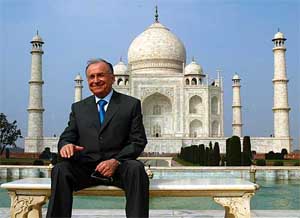
Ion Iliescu
Ion Iliescu (born March 3, 1930) is a Romanian politician. He was the elected President of Romania for eleven years (three terms), from 1990 to 1992, 1992 to 1996, and 2000 to 2004. His first and second terms were separated from the third term by the presidency of Emil Constantinescu. His successor is the former Democratic Party leader Traian Băsescu. Currently, Iliescu is Senator for the Social Democratic Party (PSD), which is the largest single political party in Romania. The PSD was one of several parties formed after the breakup of the National Salvation Front, in the early 1990s.
Iliescu is widely recognized as the predominant figure in the first fifteen years of post-1989 Romanian Revolution politics. During his terms Romanian politics stabilized, and Romania joined NATO. However, he is often accused by political opponents of retaining communist convictions and allegiances, as well as tolerating corruption in the party he led (successively named FSN, FDSN, PDSR, and PSD) and his administrations.
In 2005, investigations began that could eventually lead to Iliescu's trial on a number of charges, including crimes against humanity, related to considerable abuses of power he allegedly committed during the years 1989-1990, especially during the Romanian Revolution and the violent miners' riots of the early and mid-1990s. Supporters of Iliescu and Iliescu himself claim that the investigations are an instrument of political vengeance by his opponents currently in power.

Iliescu's father, Alexandru Iliescu, was a railroad worker with Communist views during the period in which the Romanian Communist Party was banned by the authorities. In 1931, he went to the Soviet Union to take part in the Communist Party Congress of Gorikovo, near Moscow. He remained in the USSR for the next four years and was arrested upon his return, dying in prison in 1945. During his time in the Soviet Union, Alexandru Iliescu divorced and married Mariţa, a chambermaid.

Born in Olteniţa, Iliescu studied fluid mechanics at the Bucharest Polytechnic Institute and then as a foreign student at the Energy Institute of the Moscow University. During his stay in Moscow, he was the secretary of the "Association of Romanian Students" it is alleged that he knew Mikhail Gorbachev, although Iliescu always denied this.
Politics of Romania
Iliescu: Official biography (in Romanian)
Vladimir Alexe — Ion Iliescu - biografia secretă: "Candidatul manciurian" (Ion Iliescu - The Secret Biography: "The Manchurian Candidate"); 2000; ISBN 973-581-036-0
The supplement dedicated to Iliescu (in Romanian), published by Academia Caţavencu, 22 December 2004

Monday, February 25, 2008

Eumolpus
In Greek mythology, Eumolpus (also Eumolpos) was the son of Poseidon and Chione (or Hermes and Aglaulus).
According to Apollodorus,
Eumolpus was an excellent musician and singer; he played the aulos and the lyre. He won a musical contest in the funereal games of Pelias. He taught music to Heracles.
During a war between Athens and Eleusis, Eumolpus sided with Eleusis. His son, Himmarados, was killed by King Erechtheus. In some sources, Erechtheus also killed Eumolpus and that Poseidon asked Zeus to avenge his son's death. Zeus killed Erechtheus with a lightning bolt or Poseidon made the earth open up and swallow Erechtheus.
Eleusis lost the battle with Athens but the Eumolpides and Kerykes, two families of priests to Demeter, continued the Eleusinian mysteries. Eumolpus' youngest son, Herald-Keryx founded the lines.

Sunday, February 24, 2008


Coordinates: 53°08′43″N 0°20′25″E / 53.1453, 0.3402
Skegness is a seaside town and civil parish within the East Lindsey district of Lincolnshire, England. Located along the Lincolnshire coast of the North Sea, it is 37 miles (60 km) east of the city of Lincoln, and has a total resident population of 18,910.
Skegness is perhaps best known as the location of the first Butlins holiday resort, built in 1936, which remains within the area to this day, and in this capacity, remains one of the most famous seaside resorts in the United Kingdom.

Geography

Skegness History
The name indicates that Skegness has its origin in the Danish period of settlement in England. Although it has been suggested that it looks like a foot, a hypothetical Viking responsible for establishing the earliest settlement on this location, it is much more likely to have derived from words which appear in modern Danish as skæg, beard and næs, nose or in geographical terms, headland.

Early history
See also: Butlins
The land was part of the Earl of Scarborough's estate and he, or his agent H.V.Tippet The pier has since undergone major refurbishment and is now once again a thriving tourist attraction, although it no longer extends far seaward of the high tide line.

Resort town and Butlins
In March 2005, Skegness took the top spot in a survey by Yours magazine, looking at the best retirement places in the UK. Yours researchers visited sixty likely towns, and factors involved in judging included house prices, hospital waiting lists, the crime rate, council tax rates, activities and attractions, weather patterns and ease of transport. It has also been described by Lonely Planet's Great Britain guide as "everything you could want" in a seaside resort.
Present day
Today the town's tourist industry mainly caters for working-class holiday-makers and day-trippers from Leicester, Lincoln, Nottingham and other areas of the East Midlands. Skegness has been dubbed "the Blackpool of the East Coast" or "Nottingham by the Sea", and has a famous mascot, the Jolly Fisherman (designed by John Hassall in 1908 for the Great Northern Railway), and a slogan - Skegness is so bracing - a reference to the chilly prevailing north-easterly winds that can and frequently do blow off the North Sea. The town is popularly known as Skeg, Skeggy or Skegvegas. Further up the coast are the other holiday resorts of Mablethorpe, Sutton-on-Sea, Ingoldmells and Chapel St Leonards.
The seafront teems with a variety of ways for visiting tourists to spend their money. The main strip of road along the beach is a kaleidoscope of neon and flashing lights advertising arcade machines, slot machines, fairground rides, crazy golf, fish-and-chip shops and various bars. There are also seasonal shops selling cheap ways to entertain oneself, such as kites and buckets-and-spades - such quieter pleasures can be enjoyed on the long wide award-winning beach, which in summer features a fine herd of donkeys for riding. The town is also a major centre for bowls, and is the home to the world's premier Meccano exhibition, annually staged in the Embassy Theatre, on the Grand Parade by the seafront. Behind the Embassy is Botton's Pleasure Beach, featuring roller coasters, mini merry-go-round (the Gallopers), dodgems and many traditional and modern rides, as well as the annual spectacular end-of-season firework display.
There are large Morrisons and Tesco supermarkets in the centre of the town near the railway station, and a Co-op in the Hildreds Centre shopping area. Lumley Road is the main shopping area, with plenty of fish and chip shops and pubs. To the south of the town is Gibraltar Point, a nature reserve on the northern limit of The Wash.
On 2007-08-16, a huge fire hit an entertainment complex on the Skegness front. No one was injured. The fire swept through The Parade, Lucky Strike Arcade and Buster's Fun Pub.

Tourist Industry
On the southern foreshore sits a popular family attraction, the Fairy Dell paddling pool. Closed by the district council because of health and safety fears in 2004, the pool soon became the centre of controversy as people from Skegness, elsewhere in the country and as far afield as Australia voiced their dismay at the loss of such a time-honoured free facility. Taxpayers and town councillors joined forces with the local press to campaign for the Fairy Dell to be reopened, and the district council gave way to public pressure and promised to have it back in operation by summer 2006.
On 22nd May 2006, the Fairy Dell re-opened following a major refurbishment during which many improvements were made to the pool such as clean-filtered water and extra water features. [1]
In October 2005, the East Lincolnshire Primary Care Trust closed the Scarborough Ward at Skegness Hospital as part of a package of money-saving measures. Locals were outraged by the decision, because the ward represented about a third of the hospital's entire capacity and also provided palliative care. Campaigners marched through the streets and held up the traffic, then later called for the resignations of the PCT board members after they turned down a £100,000 donation offered by East Lindsey District Council to enable the ward to remain open through the winter. The PCT said the donation would "impinge" on its duties, and could be considered "unlawful" if accepted.

Local politics

Transport
Fine beaches link the coastal towns, and there are many large caravan parks in the surrounding countryside. One caravan park a short distance to the north of the town has its own airfield, with a 755 metre grass runway. Visiting pilots can call the airfield on 132.425 MHz, although PPR (Prior Permission Required) is stated for landing. A number of years ago, pleasure flights used to operate from the aerodrome.

Airfield
The town is served by Skegness railway station, which is the terminus for the Grantham to Skegness Line. Trains run the full lengh of this and the Nottingham to Grantham Line to give direct fast convenient connections to the East Midlands.
Nottingham, Grantham, Boston and Sleaford have direct connections, while popular places such as Leicester, Derby, Lincoln and Kettering are only one change.

Railway
The A52 passes through the town from Boston to Mablethorpe and the A158 takes people from Lincoln to Skegness.

Roads
Skegness is also the home to the schools for most of the surrounding area's secondary education. Two schools cater for the 11–18 age range, St Clement's College (formerly known as the Earl of Scarborough High School) is a secondary modern on Burgh Road, and Skegness Grammar School on Vernon Road.

Media
Skegness Hospital is on Dorothy Avenue. The town also has two large GP practices, a mental health team and a PCT health centre. The latter being on Cecil Avenue.
Skegness Hair and Beauty A brand new website aimed at local Hair and Beauty outlets in and around Skegness

Saturday, February 23, 2008

Gino Cervi
Gino Cervi (May 3, 1901 - January 3, 1974) was an Italian actor of international fame.
Cervi was born in Bologna. His father was the theatre critic Antonio Cervi. In 1928, he married Nini Gordini (one of his partners) and they had a son, Tonino Cervi. Gino Cervi later became the grandfather of actress Valentina Cervi and producer Antonio Levesi Cervi.
Cervi was best known for his role of Giuseppe Bottazzi ("Peppone"), the Communist mayor in the Don Camillo movies of the 1950s and the 1960s. He shared great complicity and friendship with co-star Fernandel during the 15 years playing their respective roles in Don Camillo movies.
At the end of his career, he played Commissioner Maigret for six year in the Italian version of those murder stories, which ended with a movie Maigret in Pigalle (Mario Landi, 1966), produced by his son Antonio Cervi.
He died at Punta Ala in 1974.

Friday, February 22, 2008

John Arthur Blaikie
John Arthur Blaikie (born 1849) was an English poet and journalist, born in Paddington, Middlesex.

Thursday, February 21, 2008


Saint Nino (Georgian: წმინდა ნინო, Greek: Άγιη Νίνω),(sometimes Nina or Ninny) Equal to the Apostles and the Enlightener of Georgia, (c. 296 – c. 338 or 340) was a woman who preached and introduced Christianity in Georgia.
According to most widely traditional accounts, she was from Kolastra, Cappadocia (Greek: Καππαδοκία), was a relative of Saint George, and came to Georgia (ancient Iberia) from Constantinople. Other sources claim she was from Rome, Jerusalem or Gaul (modern France)[2] . She performed miraculous healings and converted the Georgian queen, Nana, and eventually the pagan king Mirian III of Iberia, who, lost in darkness and blinded on a hunting trip, found his way only after he prayed to "Nino's God". Mirian declared Christianity an official religion (c. 327) and Nino continued her missionary activities among Georgians until her death.
Her tomb is still shown at the Bodbe Monastery in Kakheti, eastern Georgia. St. Nino has become one of the most venerated saints of the Georgian Orthodox Church and her attribute, a Grapevine cross, is a symbol of Georgian Christianity.

Saint Nino Early Life
Nino reached the borders of ancient Georgian Kingdom of Iberia in about 320 A.D. There, she placed a Christian cross in the small town of Akhalkalaki and started preaching the Christian faith in Urbnis and finally reaching Mtskheta (the capital of Iberia). Iberian Kingdom has been influenced by the neighbouring Persian Empire which played an important role as the regional power in the Caucasus. The Iberian King Mirian III and his nation worshiped the syncretic gods of Armazi and Zaden. Soon after the arrival of Nino in Mstkheta, the Queen of Iberia Nana (daughter of King Asphagor) requested the audience with the Cappadician.
Queen Nana, who suffered from severe illness, had some knowledge of Christianity but not yet converted to it. Nino having restored her health, won to herself disciples from the Queen's attendants, including a Jewish priest and his daughter, Abiathar and Sidonia. Queen officially converted to Christianity and was baptized by Nino herself. King Mirian aware of his wife's religious conversion was tolerant of her new faith however, he secluded himself from Nino and the growing Christian community in his kingdom. However, his isolation to Christianity did not last for long. According to the legend, while on the hunting trip, the King was suddenly struck blind as the total darkness emerged in the woods. In a desperate state, King Mirian uttered the prayer to the God of St Nino:
If indeed that Christ whom the Captive had preached to his Wife was God, then let Him now deliver him from this darkness, that he too might forsake all other gods to worship Him.
In 334 A.D, Mirian commissioned the building of the first Christian church in Iberia which was finally completed in 379 A.D. on the spot where now stands the Svetitskhoveli Cathedral in Mstkheta.
Nino, having witnessed the conversion of Iberia to Christianity, withdrew to the mountain pass in Bodbe, Kakheti. St Nino died soon after; immediately after her death, King Mirian commenced with the building of monastery in Bodbe where her tomb can still be seen in the churchyard.

St Nino in Iberia